Sunday, February 14, 2010

Getting Customers to do the Advertising

Having almost a week off because of the snow gave me some time to finally catch up on some reading. I just finished 'I love you more than my dog': Five decisions that drive extreme customer loyalty in good times and bad by Jeanne Bliss, a customer service expert. The book argues that customers will naturally want to sell your product/service when your organization is genuinely guided by principles of putting customers first. Jeanne Bliss notes that this can be difficult for many organizations to actually implement because it requires a radical shift in how business is done -- It requires asking "Do my customers even want a chair?" before asking "Since we make chairs, what kind of chair should we make make?"

As Erik van Ommeren pointed out during his Me the Media lecture at Towson last fall, companies and other organizations are no longer driving how the marketplace thinks about their products/services. Potential customers are developing their opinions based on what other customers are saying. (Customer reviews are king.) In order for companies and other organizations to regain some control of how their products or services are seen in the marketplace, they need to get their customers to be willing to sell their products/services. If Jeanne Bliss is right, getting this to happen on a large scale won't just require marketing executives to learn how to write compelling tweets; it will require a massive organizational overhaul. Those of you in advertising may have your work cut out for you...

Tuesday, February 2, 2010

Editor & Publisher is Alive!

E&P was sold to Duncan McIntosh Co. Inc and is planning a February issue. The "bible of the newspaper industry" lives on!

Monday, February 1, 2010

Pay for Hulu?


According to a recent article in the LA Times, It looks like Hulu, the website created by studios to disseminate TV content, may not be free for much longer. It sounds like they are considering creating a subscription model where users would get access to the most recent episodes for free, but would have to pay to access older content. It also seems like they are thinking about charging for some of the most popular shows like House or 30 Rock.

I'm sure Hulu is hoping that it will have more success than Newsday, which has only had 35 people willing to pay $260 per year for unlimited access...

Monday, January 25, 2010

Looking for some speech inspiration?


Dr. Michael Eidenmuller of the University of Texas at Tyler has created Speech Bank: a free online database with full-text, audio, and video of over 5,000 speeches.

So whether you're looking for the text of Elle Wood's speech from Legally Blonde or video of Obama's last State of the Union address, this is a great place to find what you need.

Tuesday, January 19, 2010

News News about Old News

I know you all think nothing is more exciting than microfilm, but what if I told you that Cook Library now has a new way to look at microfilm!

ProQuest, where we get our newspapers on microfilm, has begun offering microfilm for specific newspapers digitally. Basically, it’s the same as looking at microfilm, but instead, you can do it through the web, on and off-campus, instead of coming to the library and using a microform machine.

For those of you who can't live without the microfilm machines, don't worry - we will continue to get the microfilm at the end of the year.

The newspapers covered are: Barrons, Los Angeles Times, New York Times, Wall Street Journal and Washington Post, all 2000 forward.

You can access the ProQuest Digital Microfilm archive through the database list on the library website.

Tuesday, January 12, 2010

The Great News Repackaging


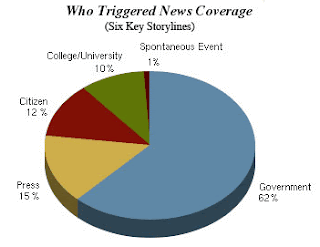
Pew's Project for Excellence in Journalism has a new study out that examines what makes up "the news." They looked at all the outlets that produced local news in Baltimore from July 19-25, 2009 and then studied the movement of six major news narratives from that week. The results are dramatic:
  • 80% of stories are just repackaged information published elsewhere
  • 63% of news stories were initiated by government officials
  • 95% of the stories that did contain new information came from newspapers
As we know, this is a tough time for newspapers so this study begs the question of who will fill the news hole if newspapers fold. It can't all be repackaged news, right?

Tuesday, January 5, 2010

H1N1 and New Media


Happy new year to all of you communication scholars out there! Looking back at 2009, one of the biggest stories was the Swine Flu and what contributed to or helped thwart its spread. The Boston Globe had a piece in December about how the Centers for Disease Control (CDC) used YouTube and Twitter to get the public information about the epidemic. The article notes the challenges of condensing complicated scientific information into 140 characters and discusses how the CDC "has become the predominant online choice for swine flu information." I think the CDC's use of new media to communicate about H1N1 will be a model for future public health communication campaigns.